

The APACE Classification Tool
A quantitative tool for describing how directives, delegations and teams are applied in organisations
Introduction
The APACE classification tool is a simple way to compare how directives, delegations and teams are applied in all kinds of groups and organisational structures, including teams, companies, not for profits, clubs, and associations.
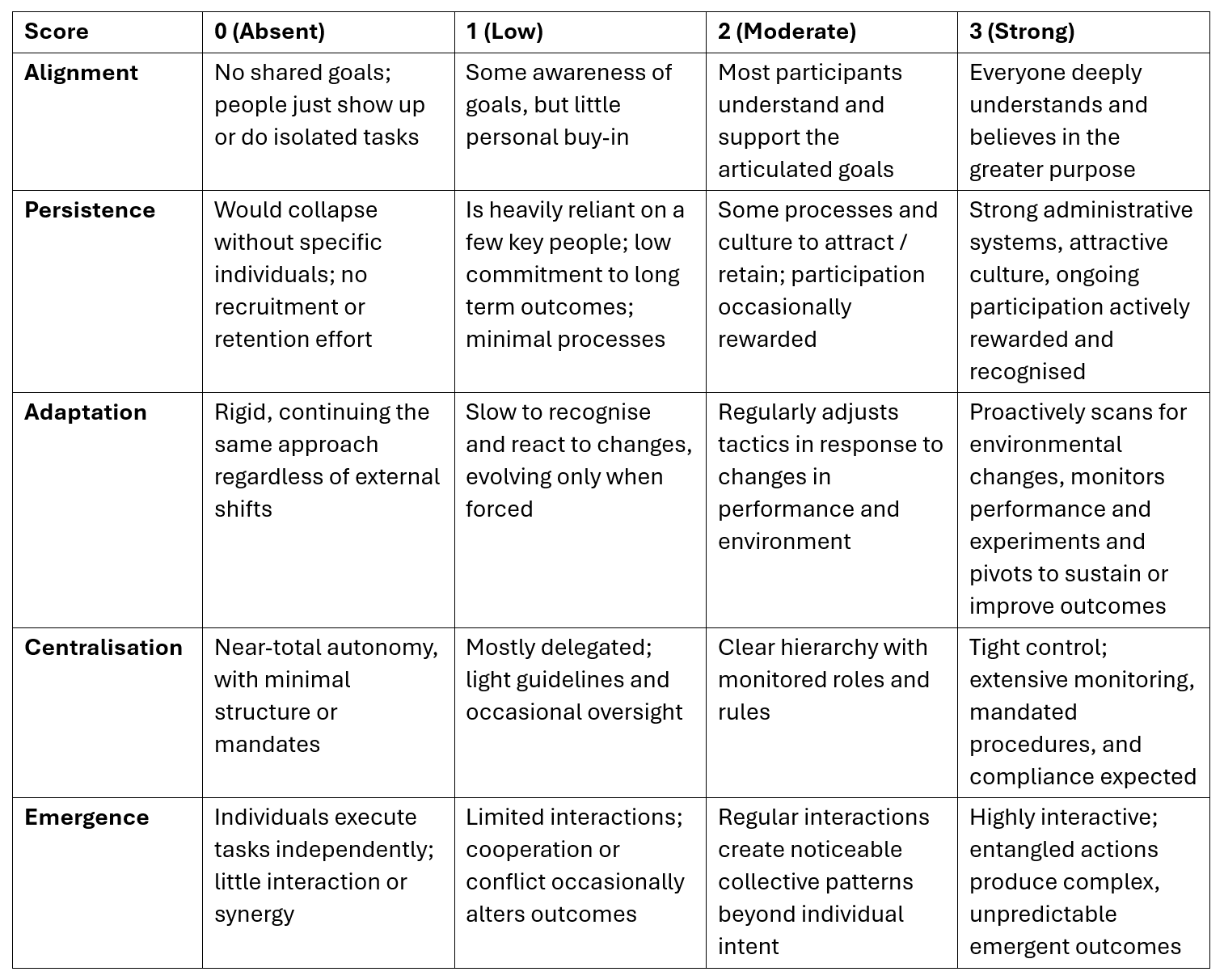
It assesses five everyday qualities relating to the group’s exhibited character:
Alignment – How strongly the group is committed to its goals
Persistence – To what extent the group could sustain itself over time
Adaptation – How easily the group makes changes when the situation shifts
Centralisation – How much individuals must follow group authority structures
Emergence – How much overall behaviours and results within the group arise from a multiplicity of interactions without central control
How to use
Review the descriptive text against the corresponding score for each dimension in the score matrix (below), and select the one that best applies to your organisation.
For greater robustness, administer the survey among multiple people and average the scores obtained. Participants should ideally be a mix of group members and independent observers.
Since the descriptions are intended to be objectively assessable, results should cluster tightly. Where there are significant variances from the mean, it may be useful to discuss these with participants to uncover the assumptions and misapprehensions that have led to a lack of consensus about the true nature of a group’s operating model.
How to apply
APACE is primarily a descriptive tool, aimed at creating a common language for discussion of organisational characteristics relating to how directives are shared, authority is delegated, and team management approaches are applied in a particular organisational context.
As such, there is no universally “good” or “bad” APACE score. Each combination of attributes is fit for purpose in some circumstances. For example, so-called ‘tiger teams’ that are established to solve a pressing, compex problem in an organisation are designed with low persistence in mind.
However, the strategies used for managing the various classes of organisation may be very different. We encourage researchers to track APACE classification as an organisational variable, seeking to either focus on recruiting a narrow class or classes, or in recruiting a broadly representative spread of characteristics when demonstration of the universal applicability of a theory or approach is being sought.