

Validating your organisational structure
Understanding why certain organisational structures thrive while others struggle can be traced back to their broader landscape alignment.
Earlier, we discussed the basic continuum of systems between designed (D) and natural (N) characteristics:
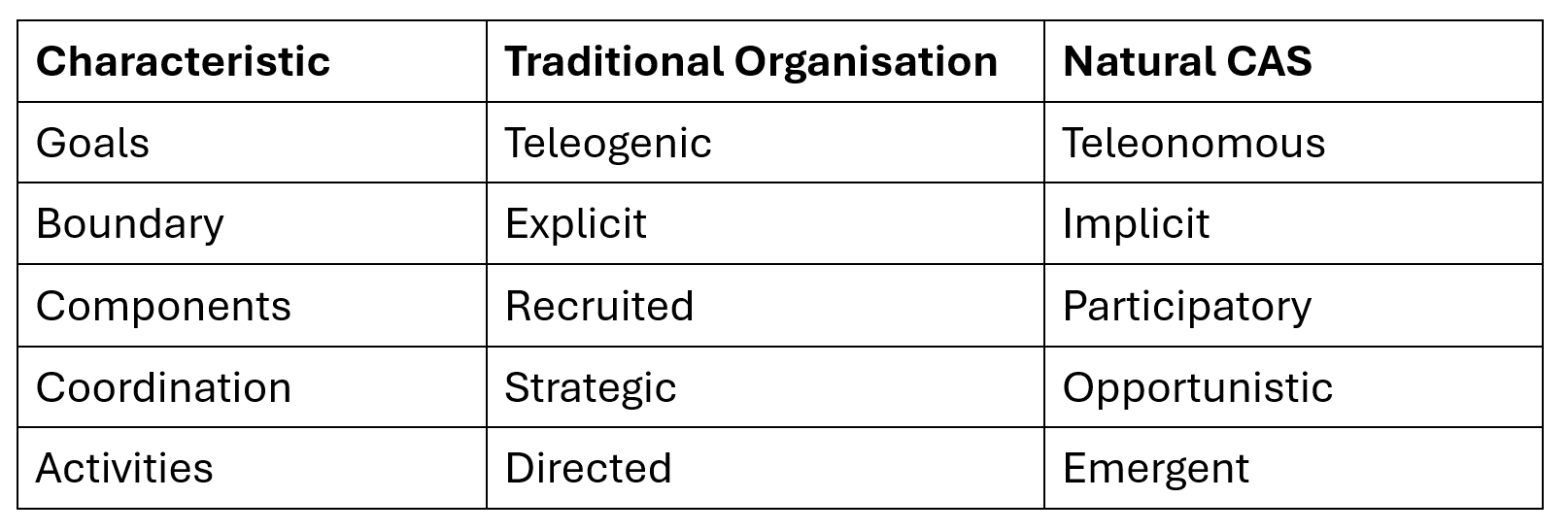
Natural systems produce self-organisation, evolution and adaptation without a top-down decision making organisation in control. Examples include consumer buying patterns, friend group formation, and voting patterns. Trends can be observed, but are not controlled.
On the other hand, what we call an “organisation” always has some degree of design, with explicit goals and an agreement to act predictably in various ways. We seek out and cooperate in organisational structures to achieve valuable outcomes that would not arise spontaneously.
While pure CAS analysis has its own fascinating dynamics, our focus here is on situations where an organisation can be meaningfully defined and analysed. By definition, an organisation must separate itself from its environment, and our analysis is in turn confined to an organisation and its domain, that portion of the larger system which meaningfully interacts with the organisation.
Every organisation can then be placed within a two-dimensional continuum “landscape score”. Both the organisation and its domain can be separately assessed as being designed, natural or a hybrid of both. Some example assessments were previously discussed by way of illustration:
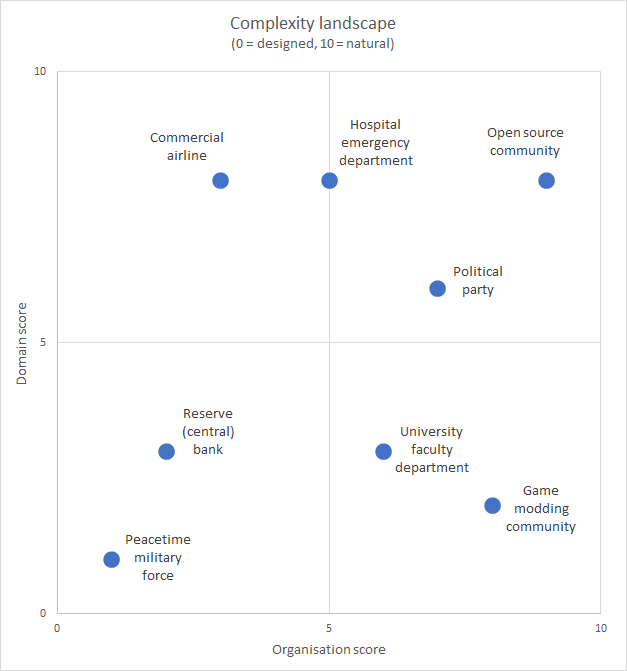
The four main landscape archetypes can therefore be described as:
Designed organisation, designed domain (DD) — Also known as the “game space” since many rules are known and respected. Highly responsive to most command-and control strategies, but these risk collapse in effectiveness if uncontrolled complexity is introduced.
Designed organisation, naturalistic domain (DN) — The home of “mission command”. Tools such as squads and documented, rigorous doctrine are commonly used to support adaptive responses in a highly dynamic environment.
Naturalistic organisation, designed domain (ND) — The “safe sandbox” space. Light-touch controls are applied in a highly controlled space to support innovation and novel outcomes, but with localised impact.
Naturalistic organisation, naturalistic domain (NN) — The “contested frontier”, where ambiguity and uncertainty reign supreme. High team discretion is granted on specific activities, bound only by basic agreement on organisational participation rules and goals. Minimal ability to direct outcomes but strong evolutionary and adaptive potential.
The second critical assessment of an organisation relates to its organisational context, sometimes referred to as its problem space. As per the framework laid out by Snowden and Boone in 2007, organisational contexts can be classified into 4 types:
Simple – Best addressed by a sense-categorise-respond decision making loop. Use accurate perception and strong categorisation of situations to enable and optimise predictable responses at scale.
Complicated – Best addressed by an analyse-solve-respond decision making loop. Leverage expertise to reliably solve hard problems and systematically implement solutions.
Complex – Best addressed by an observe-try-feedback loop. Watch what is going on, try many experiments in parallel, then amplify what works and dampen what doesn’t. Rely upon “safe-to-fail” principle in design.
Chaotic – Best addressed by a rule-act-monitor loop. Set top-down rules to provide direction that supports tangible action, then monitor for emerging patterns that can be used to stabilise local control through updated rule sets.
An organisational context is strongly influenced by its landscape position, but actualised as a result of its aggregate perceptive and execution capabilities. Broadly speaking, the Simple and Complicated contexts are best adapted to designed landscapes, and Complex and Chaotic contexts are best adapted to naturalistic ones.
However, this positioning does not guarantee a correct organisational response, nor can an organisation limit or dictate the range of situations it may potentially face solely based on its characteristics.
Attempting to operate in a context that is poorly aligned to an organisation’s landscape positioning is not impossible, but is very likely to lead to suboptimal results. There are three basic responses to address a landscape misalignment:
Change your operating context and primary decision-making loop to match your landscape position
Restructure your organisation to align to your preferred operating context
Re-engineer or rescope your domain to better match your operating context
All are potentially valid responses, depending on your organisation’s overarching goals. The idea of re-engineering a domain may seem absurd but an organisation’s domain is a subset of its environment, not the whole environment, and as such is often more tractable to organisational measures.
For example: If a shopping mall is having problems with shoplifters, security measures could be implemented to limit access. Once these domain barriers are in place, the psychological and economic drivers behind shoplifting may cease to be relevant to the stores operating in the mall.
In short:
Effective organisational performance hinges on the alignment between an organisation’s landscape positioning and its operating context
Alignment ensures decision-making loops match the prevailing conditions
Address any misalignment by adjusting your operating context, restructuring the organisation, or re-engineering domain boundaries.
Incorporating landscape archetypes into your management toolkit is a useful way to take account of real-world complexity, take practical steps to assess and plan for greater organisational resilience and adaptability, and convert structural alignment into sustained strategic advantage.